How Subtle Differences Between These Two Big Ideas Changed Our World
By: Brian Miller for AMMO.COM
You're free to republish or share any of our articles (either in part or in full), which are licensed under a Creative Commons Attribution 4.0 International License. Our only requirement is that you give Ammo.com appropriate credit by linking to the original article. Spread the word; knowledge is power!
“I see the liberty of the individual not only as a great moral good in itself (or, with Lord Acton, as the highest political good), but also as the necessary condition for the flowering of all the other goods that mankind cherishes: moral virtue, civilization, the arts and sciences, economic prosperity. Out of liberty, then, stem the glories of civilized life.”
The terms "freedom" and "liberty" have become clichés in modern political parlance. Because these words are invoked so much by politicians and their ilk, their meanings are almost synonymous and used interchangeably. That's confusing – and can be dangerous – because their definitions are actually quite different.
"Freedom" is predominantly an internal construct. Viktor Frankl, the legendary Holocaust survivor who wrote Man's Search For Meaning, said it well: “Everything can be taken from a man but one thing: the last of the human freedoms – to choose one’s attitude in any given set of circumstances, to choose one’s own way (in how he approaches his circumstances).”
In other words, to be free is to take ownership of what goes on between your ears, to be autonomous in thoughts first and actions second. Your freedom to act a certain way can be taken away from you – but your attitude about your circumstances cannot – making one's freedom predominantly an internal construct.
On the other hand, "liberty" is predominantly an external construct. It's the state of being free within society from oppressive restrictions imposed by authority on one's way of life, behavior, or political views. The ancient Stoics knew this (more on that in a minute). So did the Founding Fathers, who wisely noted the distinction between negative and positive liberties, and codified that difference in the U.S. Constitution and Bill of Rights.
The distinction between negative and positive liberties is particularly important, because an understanding of each helps us understand these seminal American documents (plus it explains why so many other countries have copied them). The Bill of Rights is a charter of negative liberties – it says what the state cannot do to you. However, it does not say what the state must do on your behalf. This would be a positive liberty, an obligation imposed upon you by the state.
Thus in keeping with what the late Murray Rothbard said above, the liberty of the individual is the necessary condition for the flowering of all the other "goods" that mankind cherishes. Living in liberty allows each of us to fully enjoy our freedoms. And how these two terms developed and complement one another is important for anyone desiring to better understand what it means to be truly free.
Etymology of Freedom and Liberty
To better understand what freedom and liberty mean, it's helpful to look at the respective etymologies of these words, digging into their histories and how they developed.
Freedom comes from Old English, meaning “power of self-determination, state of free will; emancipation from slavery, deliverance.” There were similar variants in Old Frisian such as “fridom,” the Dutch “vrijdom,” and Middle Low German “vridom.”
Liberty comes from the Latin “libertatem” (nominative libertas), which means “civil or political freedom, condition of a free man; absence of restraint, permission.” It’s important to note that the Old French variant liberte, "free will," has also shaped liberty's meaning. In fact, William R. Greg’s essay France in January 1852 notes that the French notion of liberty is political equality, whereas the English notion is rooted in personal independence.
In an interview with Lew Rockwell, Professor Butler Shaffer makes some interesting distinctions between freedom and liberty. Shaffer argues that freedom is the “condition that exists within your mind, within my mind. It’s that inner sense of integrity. It’s an inner sense of living without conflict, without contradiction, without various divisions and so forth.”
This point of view is in line with the philosophy of the Stoics. They believed that a person’s body can be physically imprisoned, but not his mind (much like Viktor Frankl famously said in his Man's Search for Meaning). Shaffer adds to the distinction:
“Liberty is a condition that arises from free people living together in society. Liberty is a social condition. Freedom is the inner philosophical and psychological condition.”
In short, freedom is inherent to humans. It exists within them by virtue of their humanity. Liberty is a political construct that allows people to enjoy freedoms such as property rights, free speech, freedom of association, etc.
Sadly, liberty has not been the natural state of mankind. History has shown that liberty – particularly of the individual – has been a distinguishing feature of Western societies, especially in the early years of the United States.
Negative Rights vs. Positive Rights
One of the structural problems with American politics since the advent of the Progressive Era in the early 20th century has been the emphasis on positive rights (aka "positive liberties," a misnomer at an individual level if there ever was one) at the expense of negative ones. What are the differences between negative and positive rights?
Philosophy professor Aeon Skoble provides a good summary:
“Fundamentally, positive rights require others to provide you with either a good or service. A negative right, on the other hand, only requires others to abstain from interfering with your actions. If we are free and equal by nature, and if we believe in negative rights, any positive rights would have to be grounded in consensual arrangements.”
For example, private property, free speech, and freedom of association are negative rights. In other words, these are rights that prevent others – above all, the state – from transgressing on you personally or on your property.
Along with these rights come responsiblities. In other words, you must bear the consequences of your actions as you exercise them. This is why you can't "falsely shout fire in a theatre and cause a panic" without bearing the consequences of the panic you caused, as Justice Oliver Wendell Holmes noted in Schenk v. United States in 1919.
Like all negative rights, free speech comes with responsibility; if you use that speech to spread information which is false and causes harm, then you're not protected carte blanche. Others can petition the court for the panic you've caused as a result of your exercise of free speech.
On the other hand, positive rights are granted by the government and involve the trampling of an individual or another class of individuals’ rights. These kinds of rights – like state-funded healthcare or public education – are justified on abstract grounds, such as the “public good” or the “general will.” By their very nature, they require the state to take from one group in order to give to another, usually in the form of taxes.
Appeals to the general will originate from the famous 18th century French philosopher Jean-Jacques Rousseau, who emphasized that a strong government makes individuals free and that individuals submit to the state for the sake of the greater good. If that sounds backwards to you, you're not alone.
Author James Bovard highlights some of the follies behind Rousseau’s thinking:
“Rousseau's concept of the general will led him to a concept of freedom that was a parody of the beliefs accepted by British and American thinkers of his era. Rousseau wrote that the social contract required that ‘whoever refuses to obey the general will shall be compelled to do so by the whole body. This means nothing less than that he will be forced to be free.’ ”
In other words, if you don't want to go along with the "will of the people" (or as Rousseau defined it, "the general will"), then the state can compell you to do so – even if that means trampling your individual rights and responsibilities.
Bovard also noted how Rousseau’s concept of freedom had nothing to do with the independence of the individual:
“C. E. Vaughan, in a 1915 study of Rousseau's work, correctly observed that, for Rousseau, ‘freedom is no longer conceived as the independence of the individual. It is rather to be sought in his total surrender to the service of the State.’ "
Rousseau (1712-78) was the first of the modern intellectuals, and one of the most influential Englightenment thinkers. He died a decade before the French Revolution of 1789, but many contemporaries held him responsible for it, and so for the demolition of the Ancien Regime in Europe.
One can see how Rousseau's ideas translated into actions when comparing the French Revolution to the American one. After all, ideas matter – especially in revolutionary politics.
French vs. American: A Tale of Two Revolutions
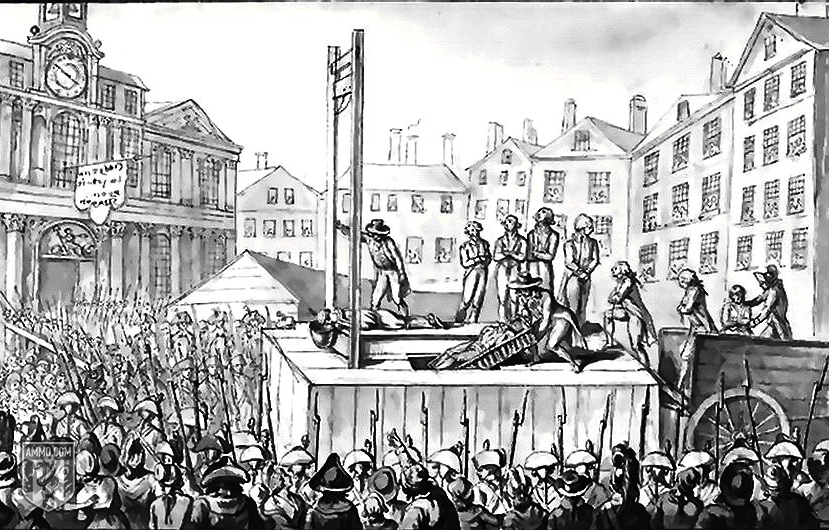
The French and American Revolutions happened within a dozen years of one another, yet they centered around two very different concepts of individual liberty. For the French, the goal was to ensure political equality. For the Americans, it was personal independence. This distinction helps shed light on what made the outcomes of the two Revolutions so different.
The French Revolution devolved into chaos when revolutionary zealots like Maximilien Robespierre became the de facto head of the Committee of Public Safety. Under the Committee’s direction, Robespierre conducted the infamous “Reign of Terror” against all opponents of the French Revolution. Robespierre was inspired in part by Rousseau, stating: "Rousseau is the one man who, through the loftiness of his soul and the grandeur of his character, showed himself worthy of the role of teacher of mankind."
If Thomas Jefferson was to Rousseau the facilitator of their respective Revolutions, then Robespierre was to General Washington – the implementor.
During his despotic period of leadership, Robespierre went as far as to create a Cult of the Supreme Being, a state religion based on secularism. This was part of Robespierre’s revolutionary program to completely destroy France’s Roman Catholic tradition in pursuit of an ambiguous "political equality" amongst the masses. Instead of trying to fight for freedom-based principles like the Founding Fathers did, Robespierre was more concerned with destroying all features of French civic society in the name of progress.
In a cruel twist of irony, Robespierre and his Committee of Public Safety behaved more like the previous French monarchy once they seized control. For that reason, the French Revolution turned into a chaotic murder spree that saw tens of thousands of people executed at the guillotine for simply opposing Robespierre’s vision. In the end, Robespierre got a taste of his own medicine, when the French National Convention arrested him and put him to death on July 28, 1794.
It took a young upstart general in Napoleon Bonaparte to put an end to the 15-year chaos of the French Revolution. France reverted back to monarchical rule when Napoleon became emperor in 1804, which restored some semblance of political stability to the crisis-beleaguered nation.
France reached great heights under Napoleon’s rule, in which the country dominated a substantial portion of Europe. However, Napoleon would be defeated and forced into exile in 1815. France went back to its monarchical system, albeit with certain republican features, when Louis XVIII assumed the throne from 1815 to 1824. France did not morph into a genuine republic until 1848, when the Second Republic was established. However, France swung from imperial to republican governments until 1871, when the Third Republic of France came into power.
The road to political stability in France was rather rocky, and was a demonstration that flawed ideas about the tenuous relationship of the state's role in an individual's life can be deadly. Unfortunately, most countries across the globe have taken after France’s example of governance as opposed to the American model.
Latin America is arguably the best example of this.
Condemned to Mediocrity: Latin America’s Misunderstanding of Liberty

Etched above the entrace to the Colombian Palace of Justice is a quote by General Francisco de Paula Santander:
"Colombianos las armas os han dado la independencia, las leyes os darán la libertad" (Colombians arms have given us independence, laws will give us liberty)
Santander’s quote was indicative of the stark difference in political philosophies of the Latin American Wars of Independence from Spain and the American War of Independence from Great Britain. He and his counterpart, Simón Bolívar, were not inspired by classically liberal ideas of an individual's inalienable rights – hence Santander’s belief that liberty comes from the state, not from natural law as Thomas Jefferson wrote in the American Declaration of Independence:
“We hold these truths to be self-evident, that all men are created equal, that they are endowed by their Creator with certain unalienable Rights, that among these are Life, Liberty, and the Pursuit of Happiness. That to secure these rights, Governments are instituted among Men, deriving their just powers from the consent of the governed.”
Jefferson's philosophy held that an individual's unalienable rights are not given to one in a document, but by their Creator (and subsequently codified in the Bill of Rights "in order to prevent the misconstruction or abuse of its powers" as it states in the preamble.) In other words, an unalienable right is God-given. It isn’t granted by a president, a king, or any government – otherwise it can be taken away.
Santander and his counterpart Bolivar didn't share Jefferson's view. Juan Baustista Alberdi, one of Latin America’s premier classical liberal thinkers in the 19th century, understood the major distinctions behind the Latin American and American Wars of Independence in his essay Omnipotence of the State:
“Washington and his contemporaries were more interested in fighting for individual rights and liberties than just fighting for independence of their country. Once they attained the former, they were able to achieve the latter, as opposed to South American countries, who won their political independence but did not obtain individual freedoms.”
The Founding Fathers fought, above all, for the restoration of the liberties they enjoyed as Englishmen, which were usurped by the tyranical King George III. On the other hand, Latin American leaders were fighting for independence from Spain – and not much else. There wasn't an underlying belief in an individual's unalienable rights. Instead, in their view, these rights were granted by the state and their laws, and consequently could also be taken away.
Bolivar in particular feared introducing too much liberty to the uneducated masses once Spainish rule ended. He foresaw anarchy, and thus believed in the necessity of a strong central authority once Gran Colombia gained independence. (Gran Colombia was made up of Colombia, Ecuador, Panama, and Venezuela.) These were the views of a man raised in the Caracas elite.
Bolivar (1783-1830) was born into aristocracy in Caracas. He was a product of the Enlightenment, and was strongly influenced by Jean-Jacques Rousseau. Just like Robespierre in France, Boliver was entranced by Rousseau's ideas. In particular he subscribed to Rousseau’s “general will” concept, which called on the intellectual and educated elite to identify what's in the best interest of the people. Picture the state serving as a "benevolent guiding hand" if you will; except that it won't be benevolent if you don't go along with where that hand is guiding you.
Bolívar believed that past subjugation under Spanish colonial rule left many of the Gran Colombia people ignorant and unable to acquire knowledge, power or civic virtue. Therefore, supposedly in the name of the "greater good," Bolívar believed that these people should be freed – but not given too much individual liberty. He says as much in his famous Cartagena Manifesto, where it's clear he was not a fan of federalism:
“But what most weakened the government of Venezuela was the federalist structure it adopted, embodying the exaggerated notion of the rights of man. By stipulating that each man should rule himself, this idea undermines social pacts and constitutes nations in a state of anarchy. Such was the true state of the confederation. Each province governed itself independently, and following this example, each city claimed equal privilege, citing the practice of the provinces and the theory that all men and all peoples have the right to institute whatever form of government they choose. The federal system, although it is the most perfect and the most suitable for guaranteeing human happiness in society, is, notwithstanding, the form most inimical to the interests of our emerging states.”
In Bolívar’s view, the 1812 collapse of the First Republic of Venezuela was due to its decentralized federal system, which demonstrated that the First Republic in fact needed to have stronger state control. After independence was achieved throughout most of Latin America in 1821, Bolívar established Gran Colombia – an even larger territory with stronger centralized power.
Bolívar had lofty aspirations for Gran Colombia. He saw it as a potential powerhouse that would rival the U.S. and European powers by implementing Rousseua's "general will" concept. However, Bolivar’s dreams did not go as planned. By 1828, Gran Colombia was on the ropes due to internal turmoil and political infighting.
There is a parallel here with the U.S. Articles of Confederation. It lasted eight years before the Continental Congress in Philadelphia replaced it with the U.S. Constituion, primarily because the federal government was too weak to pay their Revolutionary War debts. Gran Colombia lasted seven years before it began to implode. However, unlike the Continental Congress, which convened to replace the U.S. Articles whilst still protecting an individual's inalienable rights, Bolivar dissolved the Constitutional Convention of Ocaña because he was unable to reform the Constitution of Gran Colombia. He then did what all good dictators do – he declared himself in charge of the Republic of Colombia, making it abundantly clear that Colombia was in fact no longer a republic.
The Gran Colombia experiment would come to a grinding halt in 1830, when Ecuador, New Granada (present-day Colombia), and Venezuela decided to break away and carve out their own national paths.
Gran Colombia’s dissolution made Bolívar pause and reflect. At the end of his life, he'd been driven out of politics, into exile, and knew he would die soon. In his letter to General Juan José Flores, Ploughing the Sea, Bolívar was blunt about his concerns for Latin America’s future:
“You know that I have ruled for twenty years, and I have derived from these only a few sure conclusions: (1) (Latin) America is ungovernable, for us; (2) Those who serve revolution plough the sea; (3) The only thing one can do in (Latin) America is emigrate; (4) This country will fall inevitably into the hands of the unrestrained multitudes and then into the hands of tyrants so insignificant they will be almost imperceptible, of all colors and races; (5) Once we’ve been eaten alive by every crime and extinguished by ferocity, the Europeans won’t even bother to conquer us; (6) If it were possible for any part of the world to revert to primitive chaos, it would be (Latin) America in her last hour.”
Since then, Latin America would experience decades of political and economic instability. Despotism, the non-existence of the rule of law, and economic interventionism have been hallmarks of Latin American politics for the past century and a half. One could argue this is due to the fact that there is no philosophical basis in an individual's unalienable right. It is only a matter of power.
One needn’t look further than present-day Venezuela to see what happens when collectivism becomes part and parcel of the political culture. Ideas like individual liberty and personal responsiblity form the philosophical bedrock of a functioning republic. Their adoption can be the difference between generational poverty or prosperity for nations.
A Warning to the United States
The manipulation of what liberty and an individual's rights and responsibilities constitute has already made its way to the U.S., where the lack of understanding of what liberty truly means has been apparent since the advent of the Progressive Era.
During this period, political pundits and economic theorists became obsessed with scientism, which is “the over-reliance on or over-application of the scientific method” as a means of trying to move society forward towards an ambiguous utopia. Instead of focusing on the defense of foundational principles like liberty and the rights and responsibilities of the individual, 20th-century intellectuals focused more on “scientific” ways to plan society from the top down. The state would obviously be the main driver, and its central planning would make people “free."
However, such a view encountered pushback during the 20th century. Economist Ludwig von Mises courageously stood up to this top-down vision and exposed the limits of science in his work Planned Chaos:
“Science is competent to establish what is. It can never dictate what ought to be.”
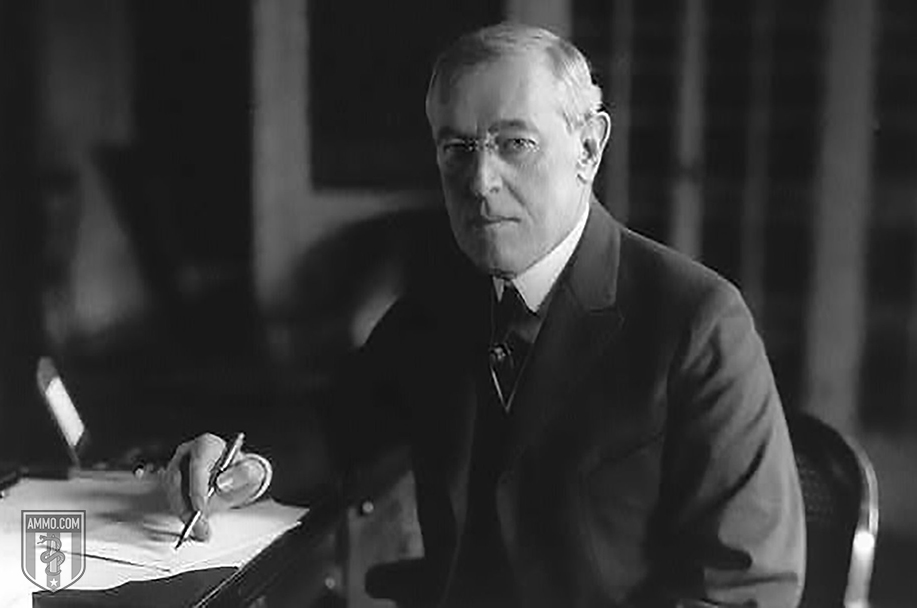
Mises’ warning unfortunately fell on deaf ears. Progressivism’s apex came about during the administration of Woodrow Wilson.
In that period, the income tax and the Federal Reserve were established, while the U.S. embarked on its most expansive foreign adventure to date when the Wilson Administation (supported by powerful bankers like J.P. Morgan) led America into World War I under false pretenses, lying about the sinking of the passenger ship Lusitania by German submarines. This war would pave the way for increasing levels of government intervention, as witnessed during the New Deal and Great Society Eras where the warfare/welfare state became even more consolidated. To this day, Washington's power in the lives of private citizens continues to grow without much pushback.
Discussions about freedom and liberty – as well as the important distinction between negative and positive liberties, which form the bedrock of the U.S. Constitution and Bill of Rights – have become quite quaint, as people use these words in Orwellian fashion to justify a litany of government intrusions in our lives. When we let their meanings become obscurred, we cede to those whose underlying goal is more state power the ability to manipulate the public for their own tyrannical ends. We not only need to comprehend the differences between freedom and liberty, but also recover their original meaning so that there is foundational clarity in political discussions.