Unruly State of Affairs in the United States of America

USOA v2.0 -- April 2025 -- Education & Outreach Committee -- HelpDesk Support is available... Click here to visit the Contact Page...


by: James Allen Homyak, November 26, 2023

Saving democracy? Why do we care? I don't care about politics.  I do care about crime.

Is this topic:  Threats to our democracy one of the "primary concerns we hear in the mainstream media" about circumstances becoming a threat to our democracy?


Let's get into detail...

America is made up of the republic, which we accept as our union of 50 states. Then we also have the District of Columbia and the anciliary possessions which are these:

  • Territories, 5 inhabited
    • American Samoa
    • Guam
    • Northern Mariana Islands
    • Puerto Rico
    • United States Virgin Islands

  • 9 uninhabited
    • Baker Island
    • Howland Island
    • Jarvis Island
    • Johnston Atoll
    • Kingman Reef
    • Midway Atoll
    • Navassa Island
    • Palmyra Atoll
    • Wake Island

  • 2 disputed
    • Bajo Nuevo Bank
    • Serranilla Bank


Question: Now where in all of this does "a Democracy" actually exist to do our nation's business?

Answer: only the District of Columbia and some of the Territories

Americans again, have been constantly hoodwinked by the powers that [shouldn't] be. 

We, those of us born and living in the 50 states, have a republic to defend. We have founding documents which tell us that we are owed a republican form of government... but the Organic Law Documents gets trampled by the globalists, the corporations, foreign powers and the central bank.

One researcher, who has over 50 years of her life involved, is Anna Maria Riezinger, aka Anna von Reitz, a recognized Alaska Superior Court Justice and internet guru in the effort of reconstructing our local, county and state governments and to educate people in matters where our public education has failed us.  Here is a link to her "democracy" findings


By: Ray DiLorenzo


Democrat Bizarro World

“The survival of democracy depends on a Democratic presidential victory in 2024, and no one else has stepped up to carry the burden.”
~F. Wilkinson, Bloomberg

The quote from Mr. Wilkinson is nonsense, of course. Democrats have been hawking that slogan for years, reliant on your ignorance to apply any meaning.  They live in a bizarro world.  Everything is opposite. If they say they are fighting for democracy, they are fighting to destroy it.  If they say the border is closed, it is open—wide open. If they say they are transparent, they are anything but.  Even their name is a misnomer.  It is the strategy of the lie—the goal of every dictator, communist, fascist, or anarchist.  Repeat the lie often enough, and someone will believe it.

Democrats are losing support across the board—the young, the old, Blacks, Hispanics, and women.  Their support or lack of it is not just about votes.  It’s about turnout.  Support for Democrats is meaningless if the candidate(s) gives them no impetus to actually vote.  Not to mention the goings on during the vote count in 2020.

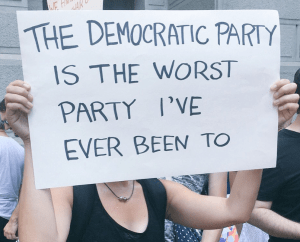
What is so wrong with the Democrat Party is twofold: they are now messing with people’s freedom and their stuff—their culture, their money, families, homes, mortgages, education, their food, their cars, their faith, and their ELECTIONS. In just a few short years, lifestyles have changed, and not for the better. Many people, especially the young, cannot afford homes or even rent. The attack has been and continues to be on the middle class—the very core of America.  And, for a political party, they have been found to be the worst thing you can be—anti-American.

The other is easy to see. Democrats are becoming autocratic. 

They have embraced censorship, and at every turn they go for more government and more control.  In New York State, Gov. Hochul is showing the country the plans the Dems have for us.  Quarantine Rule 2.13 has passed muster with the NY Appellate Court.  In New York State, the government can lock you down, quarantine you, remove you from your home, force you into an internment camp, and force you to take a vaccine, even if it is experimental… without notice or due process. Sounds more like the Soviet Union to me.

Like their globalist brethren, the Left is resolute on people control, still encouraging COVID vaccines when most people have already figured out they don’t work. They want to decide what cars people can drive, even requiring a kill switch in all new cars by 2026, and now demanding a minister of truth.  Pontius Pilate didn’t even know what truth was. Can you imagine the government being able to turn your car off or decide what is true or not?… all totally antithetical to the American way of life.

Are Democrats capable of massive nation-wide election fraud?  Absolutely.  Can the Democrats turn a peaceful protest into a riot by using hundreds of federal agents to stir the pot in the crowd?  You bet.

And they believe we are better off today than we were three years ago.  Democrats are very much a ‘Are you going to believe us or your lying eyes?’ party.  All very Stalinesque.

Part of the confusion among Democrats is that most of them have no idea what Republicans think about anything.  They have segregated themselves from most of the people they represent. Democrats tend to hang with only Democrats. They’re apt to live in liberal enclaves. They get their news from CNN, MSNBC, The New York Times, and the Washington Post and think that PBS, NPR, and fact-checkers are reliable sources of information.

We know what Democrats think, if think is the right word. Democrat philosophy is everywhere: radio, TV, internet, movies, education, and newspapers. It is anti-God and antifreedom.  They are loud, insistent, take no prisoners, demand this, demand that, and common sense be damned. They appear and travel in packs like wolves. They have this tendency toward ‘righteous’ indignation, selling things like never-ending welfare or abortion like it is the virtuous thing to do. Many Republicans understand what abortion means to the people involved, but to demand abortion late in pregnancy or up to the time of birth shows a monumental lack of humanity as well as morality.

Their lockstep mentality is impressive, if not curious. I’ve always believed that if everyone in the room agrees about everything, you have too many people in the room. They are a curious bunch.  They invest millions of dollars in movies trying to teach us a lesson in liberal-think, and when it inevitably bombs, they keep trying again and again.   Who are those investors?

If you judge Democrat-think by what they teach in school, you go away convinced that America is an awful place.  You get the impression that we invented slavery and that the Indians were living in harmony with one another until we showed up. Schools are beginning to teach students, especially in deep blue states, which sources of information are trustworthy—reminiscent of book burning in Nazi Germany.

Who thought that defunding the police or not prosecuting criminals was going to result in less crime?  Who thinks that requiring voter ID is voter suppression?  This is common-sense stuff.

Republicans and Democrats can agree on some things. And it’s not always good. A collection of Republican clubs endorsed a tax on carbon pollution.  When asked in a survey:

“Should the US participate in the Paris climate accord and reduce greenhouse gas emissions regardless of what other countries do?”  A majority of voters in both parties said yes.  Does that mean they are right? Of course not.  In today’s world, what it means is that the global elites’ investment of hundreds of billion dollars in propaganda is working.  Unfortunately, the vast majority of people get their information from propaganda—politicians and ‘educators’!   I am fortunate to get my information from a Ph.D. (Dr. Edwin Berry) who has written books on climate change and is convinced in a very scientific sort of way that it is a hoax.  We do not cause climate change.  And it is a tool—a weapon—of the globalists to radically change the lifestyles of billions of people.  They want ultimate control over every living thing on the planet, and a climate change scare is one of their tools.

Another example is the recent vote on whether to refer an article of impeachment to Homeland Security Secretary Mayorkas.  Eight Republicans voted with Democrats, a disgusting display of hear no evil, see no evil.  Mayorkas is a criminal, the cause of thousands of lives lost due to a purposely out-of-control southern border.

With no honest elections and no borders, we cease to be a country.

Whether the Democrat Party implodes or not is not the real question. It is not even important.  The question many ask under their breath is whether we will have an honest election in 2024. Election integrity is a subject no one in the media, including Fox News, seems to be allowed to talk about.

When Democrats say Republicans want to move backwards, many voters, including Democrats, are beginning to realize it’s not such a bad idea.

Source: Stand Up America


  •  


    THE ABUNDANCE PARADIGM: WHY AI FORCES A RETHINKING OF MONEY ITSELF — PART 1

    By Ellen Brown on May 11, 2026

    A Universal Basic Income (UBI) has long been proposed as a way to cushion the blow of jobs lost to automation. Under that model, everyone receives a modest monthly payment – enough to cover basic needs and prevent extreme poverty. 

    But Elon Musk has gone further. On April 16, he posted on X:

    Universal HIGH INCOME via checks issued by the Federal government is the best way to deal with unemployment caused by AI.

    Rather than a subsistence stipend, Universal High Income (UHI) would be a level of income allowing ordinary people to live well in a world where machines do most of the work. Musk has also said that AI and robotics are the only things that can solve the massive U.S. debt crisis. 

    That sounds promising, but where will the government get the money to pay the UHI? Critics say any government that tried it would go bankrupt. There are also other concerns, which will be addressed in Part 2 of this article. Here we will look at the financial underpinnings: why UHI is even thinkable, why AI forces a reexamination of how money enters the economy, why the current system cannot scale to meet what is coming, and the implicit transition needed to meet that challenge.

    Why the Current Money System Cannot Scale

    The national debt of the U.S. government just topped $39 trillion. China’s is $18.7 trillion. Japan’s is $8.6 trillion. Those of the UK, France, Germany, Italy and Spain are each in the multi-trillion-dollar range. Collective global debt now stands at $353 trillion, 305% of the world’s annual economic output. So even if, hypothetically, everything produced in the world in a year were applied toward liquidating the debt, it still would not be enough to pay it all off. 

    In fact the debt can never be repaid, because of the way money currently enters the system. Nearly all of the money supply today is created by banks when they make loans. Banks do not lend their existing capital. The loan itself creates the money. The bank adds the loan amount to the asset side of its balance sheet and balances that sum with the same amount on the liability side. When the borrower withdraws or transfers the funds, either the bank takes them from its reserves in “vault cash” or the Federal Reserve debits the bank’s digital reserve account at the central bank. But the lending bank typically has funds coming into its reserve account at about the same rate as they are going out, so its reserves are continually replenished. Thus a very small reserve account can support a much larger money creation engine. For decades before the Fed discontinued the reserve requirement in 2020, it hovered at around 10%.

    The chief problem with this debt-based system is the interest, which the bank does not create in its original loan. For a typical long-term loan, interest can double the total tab or more. Where is the money to come from to pay this added liability? Across the system as a whole, it must either come from more borrowing or from existing funds. In the case of governments, that means issuing interest-bearing bonds or tapping taxes and other revenues. The interest on the debt compounds, meaning the government is paying interest on interest. This makes the debt increase exponentially, until it is mathematically unsustainable. Then bankruptcies occur, of banks or even whole governments. Booms turn into busts, and the cycle begins again.

    Today, interest on the federal debt is the second largest budget line item after Social Security, exceeding $1 trillion. Meanwhile, workers are losing jobs to AI/robotics, shrinking the income tax base. The system is clearly unsustainable.

    How to Raise Demand to Scale to the Upcoming Supply

    A Universal High Income would replenish the shrinking tax base by replacing the lost wages of unemployed workers. But where will the money come from to pay the UHI? The only sustainable solution is for the government to issue it interest-free. That does not mean through the Federal Reserve, which creates money in the same way banks do: it buys federal interest-bearing securities with accounting entries. The Fed collects the interest, which it is supposed to return to the Treasury after deducting its costs. But since 2008, its costs include paying interest on the reserves of its participating banks, which consumes its profits. (See my earlier article here.) 

    The only interest-free, debt-free solution that will actually increase the money supply sufficiently to match the projected productivity of AI/robotics is for the money to be issued directly by the Treasury.

    This is not a radical new idea. It is authorized in the U.S. Constitution, which provides in Article 1, Sec. 8, that “The Congress shall have Power To … coin Money [and] regulate the Value thereof .…” Abraham Lincoln used government-issued “Greenbacks” to avoid a crippling debt to British-backed bankers. Debt-free government-issued money was also the funding mechanism by which the American colonists succeeded in creating a thriving economy and liberating themselves from the oppressive yoke of the British Empire.

    In his 1729 pamphlet “A Modest Inquiry into the Nature and Necessity of a Paper-Currency,” Benjamin Franklin argued that a lack of currency was a tax on industrious farmers and producers, and that a reliable, locally issued paper currency was the “oil” for the gears of trade. The “Nature and Necessity” of this currency was to facilitate the movement of goods between neighbors. Franklin observed that the British strategy of keeping the colonies short of cash was a method of economic suppression. By forcing the colonies to use gold and silver, which were constantly drained back to London to pay for imports, the Crown kept the colonies in a state of permanent debt and low productivity. When the money supply matched the productive capacity of the people, universal prosperity resulted without inflation. 

    This logic evolved into the “American System of Political Economy” championed by Henry Carey, economic advisor to Abraham Lincoln. He wrote:

    Two systems are before the world… One looks to pauperism, ignorance, depopulation, and barbarism; the other in increasing wealth, comfort, intelligence, combination of action, and civilization. … One is the English system; the other we may be proud to call the American system, for it is the only one ever devised the tendency of which was that of elevating while equalizing the condition of man throughout the world.

    In the context of the 21st century, the “oil” that best lowers the friction of trade is debt-free government-issued money similar to Lincoln’s Greenbacks and colonial scrip. Rather than implementing a radical financial innovation, we would be returning to our roots.

    Inflation or Deflation?

    The chief objection to the colonies’ paper “scrip” was that they tended to over-print, so that “demand” (money) outstripped supply. Too much money chasing too few goods produced price inflation. But in the 21st century, we will soon have the opposite problem: too little money chasing too many goods. Machines don’t need food, clothing, shelter, transportation, medical treatment or other services. So who will buy those goods and services? 

    Money needs to be issued to human consumers, and not just to a few wealthy human consumers serving as debt brokers thriving on interest. To create sufficient demand for the voluminous output of AI/robotics, it needs to go to the whole national population, evenly distributed. Not only can UHI work in that sort of abundant supply without producing price inflation; it is actually essential to prevent deflation.

    In a conversation on X, Musk wrote:

    In a normal economy, issuing more money simply increases the dollar price of the existing output of goods & services, meaning people do NOT get more stuff. If AI/robotics massively increase goods & services output, then you actually MUST issue dollars to people or there will be massive disinflation. 

    As paraphrased on Yahoo Finance (reposted from Benzinga), Musk wrote that handing out more dollars becomes a problem only when the economy’s supply of goods and services fails to surge alongside the money supply. His claim is that AI and robotics could lift production so sharply that the bigger risk would be falling prices, not rising ones.

    But aren’t falling prices a good thing? In this case, no. Prices would be falling due to a lack of demand, meaning producers can’t find customers for their products. They wind up laying off workers and eventually going bankrupt. When spread across the whole economy, the result is a deflationary spiral: prices fall, businesses lose revenue, and the economy contracts, not because production is inadequate but because purchasing power is insufficient. The result is recession or depression. In the Great Depression of the 1930s, food was rotting in the fields while people were starving, because they were out of work and had no money to spend. 

    Job cuts from AI are already happening. According to the same Benzinga article:

    Evidence of near-term strain is showing up in corporate announcements: employers disclosed more than 27,000 job cuts linked to AI in the first quarter of 2026, according to Challenger, Gray & Christmas. The outplacement firm said that figure was up 40% from the same period a year earlier. 

    Robert Reich reports that wages are around two-thirds of the typical corporation’s total cost, and that in the first four months of 2026, big U.S. corporations cut over 128,000 jobs. 

    How Soon Will All This Happen?

    Another Benzinga article, reposted on Yahoo Finance on March 16, detailed Musk’s projected time frame:

    Speaking remotely to the Abundance Summit last week, Musk told XPRIZE founder Peter Diamandis that the global economy is on the verge of an explosion so massive it defies historical precedent.

    “I’d say the economy is 10 times its current size in 10 years,” Musk said, before quickly clarifying that the growth could be even more explosive. “Greater than,” he added, framing the projected shift in economic output as a “fairly comfortable prediction.” …

    Ray Kurzweil, author of The Singularity Is Near, sees AI reaching Artificial General Intelligence (human-level intelligence across virtually all domains) by 2029, and full transformative abundance by 2045.

    Other experts question these time projections, but a radical transformation of traditional manufacturing and trade is likely to happen sometime in the reasonably near future. The question is, will the money system transition soon enough to rescue all the laid-off workers from homelessness and famine?

    The Sovereign Wealth Fund Alternative

    There is another model for distributing the gains of automation, one that can be phased in gradually as the AI workforce expands. It comes from Sam Altman, CEO of OpenAI. In an ironic twist, Altman and Musk, who jointly founded OpenAI in 2015, are now locked in a high-profile legal battle over whether Altman diverted Musk’s $44 million investment to transform what was conceived as a nonprofit “for the benefit of humanity” into a highly lucrative for-profit enterprise.

    That dispute aside, Altman’s alternative model for sharing AI-generated wealth is a national sovereign wealth fund seeded by the profits of AI and robotics. His proposed American Equity Fund would take public stakes in the companies and technologies driving automation, capture a portion of the resulting productivity gains, and distribute them as universal dividends. The Fund would not replace a Universal High Income but would complement it.

    This approach has several advantages. It ties payments directly to real output, scales automatically with productivity, and can be introduced gradually, avoiding the shock of issuing large payments before the supply side has fully expanded. It would resemble the Alaska Permanent Fund, which distributes oil revenues to residents, except that here the resource would be the most powerful general-purpose technology since electricity.

    Conclusion: A New Monetary Logic for a New Productive Era

    For centuries, money has been issued as a claim against the future productivity of human labor, repaid from the income that labor generates. The logic of this debt-based system collapses when machines become the primary producers of goods and services. Then the limiting factor becomes purchasing power — the ability of human beings to access the abundance their own technologies create. That requires a monetary architecture that expands with output rather than debt, and distributes income not through wages alone but through mechanisms tied to the productive capacity of the whole system.

    Universal High Income and a sovereign wealth fund are two ways of doing that. One ensures a stable floor of demand; the other ensures that the public shares in the gains of automation. Both would be grounded in real production. But for the public to have access to those gains, the money supply needs to expand in proportion to the expanding pool of goods and services. This can be done by restoring the innovation our forefathers baked into the Constitution: debt-free money issued by the government itself.

    How to fund a UHI without triggering inflation or driving the government into bankruptcy is the first objection critics raise, but there are others. They argue that people would stop working or stop learning, that society would collapse into idleness or chaos, that life would lose meaning without jobs, that the government would have the power to control how people spend their money.  Will a UHI ring in the promised utopia or lock us into a state-controlled digital prison? Part 2 of this article will address those concerns. 

    _______________

    This article was first posted as an original to ScheerPost.com. Ellen Brown is an attorney, founder of the Public Banking Institute, and author of thirteen books including Web of DebtThe Public Bank Solution, and Banking on the People: Democratizing Money in the Digital Age. Her 400+ blog articles are posted at EllenBrown.com.tom of Form


  •  

    WAY TO GO MR PUTIN - RUSSIA FINALIZES 'LBGTQ PROPAGANDA' BAN

    Posted By: The_Fox [Send E-Mail]
    Date: Thursday, 1-Dec-2022 05:31:08
    www.rumormill.news/212414


    Many a time I often think about moving to Russia, so sick and tired of living here in the West.

    Over there things get done and child molesters etc don't just get away with a slapped wrist, free to again prey on the innocent.

    Those promoting society's moral decay will now have to answer for their actions also.

    Way to go Mr Putin.

    Read more: 'LBGTQ PROPAGANDA' BAN